

- Introduction
- What Is Payroll Allocation by Percentage?
- How to Calculate Payroll Allocations by Percentage
- How to Handle Taxes, Benefits, Rounding, and Adjustments
- Documentation, Compliance, and Common Mistakes
- Conclusion
- Frequently Asked Questions
Table of contents
Last Update: August 2026
Payroll is often one of a nonprofit's largest expenses. When an employee supports more than one grant, program, or organizational function, charging the full cost to a single category can distort grant balances and functional expense reports.
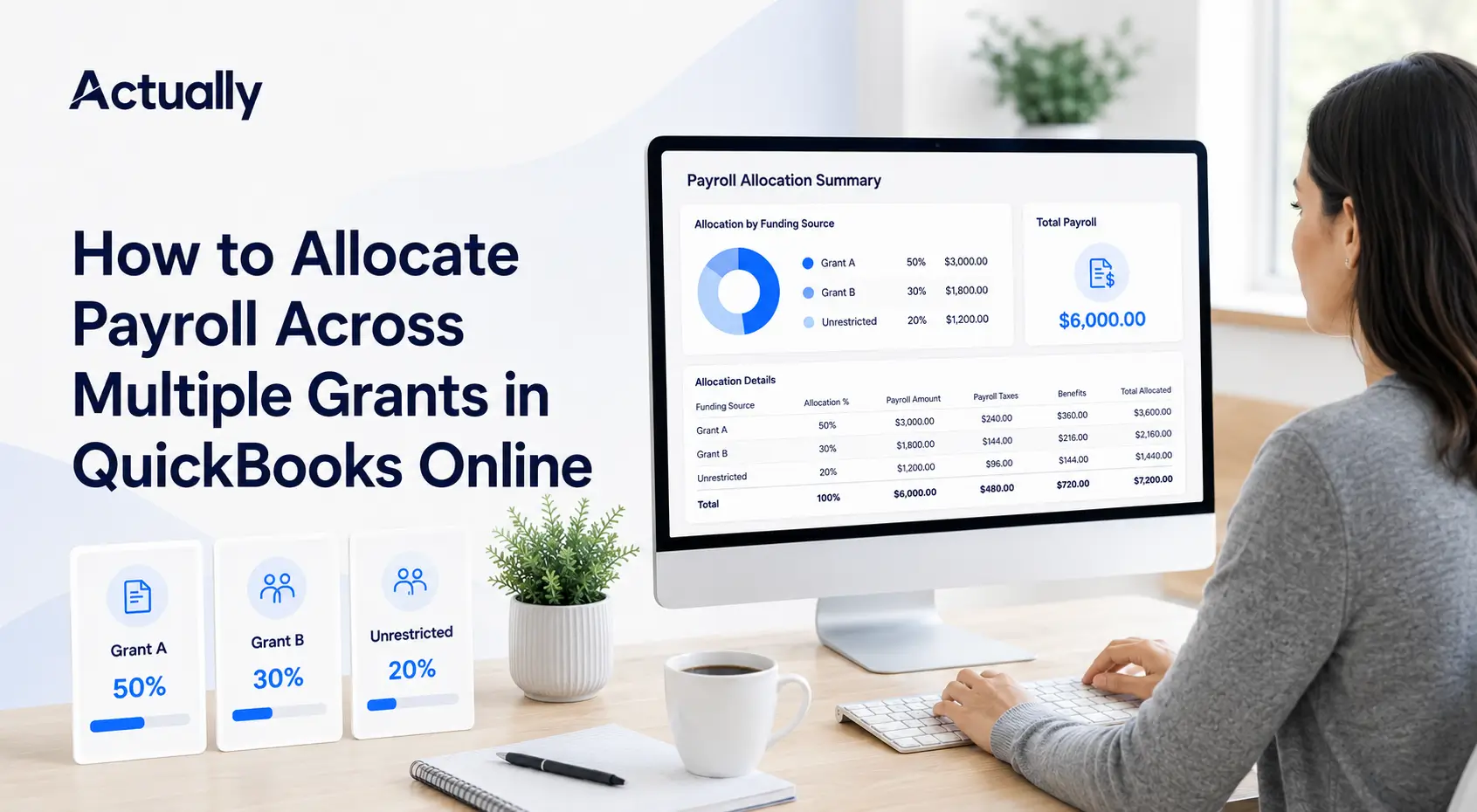
Payroll allocation by percentage solves the calculation problem by dividing an employee's compensation among the activities that benefited from the work. The basic arithmetic is simple: multiply the allocable payroll cost by the percentage assigned to each cost objective. The challenging part is selecting percentages that reflect the employee's actual work, applying them consistently, and retaining adequate support.
This guide explains the payroll allocation formula, walks through realistic examples, and covers taxes, benefits, rounding, adjustments, and documentation. It is intended as general educational information. A nonprofit should also follow its written policies, grant agreements, applicable regulations, and advice from its accountant or grants professional.
Key Takeaways
- The basic payroll allocation formula is allocable payroll cost × allocation percentage = allocated payroll cost.
- Percentages should have a reasonable, documented connection to the work performed or benefit received.
- Salary, employer payroll taxes, and benefits may require separate calculations because award terms and accounting policies can treat them differently.
- When the entire payroll amount is distributed, the percentages should total 100%, and the allocated dollars should equal the source payroll total.
- For federal awards, budget estimates may support interim accounting, but they generally cannot serve as the final support without records that accurately reflect the work performed and any required adjustments.
What Is Payroll Allocation by Percentage?
Payroll allocation by percentage is a method of distributing an employee's payroll costs among two or more cost objectives. A cost objective may be a grant, contract, program, department, location, or functional category such as program services, management and general, or fundraising.
For example, if an employee spends 45% of the period supporting Grant A, 35% supporting Grant B, 15% on management and general activities, and 5% on fundraising, the organization can use those percentages to divide the employee's allocable payroll cost.
Percentage-based salary allocation is the calculation method. It is not, by itself, the supporting evidence. The organization still needs records and controls appropriate to its funding requirements.
Payroll Allocation Formula
The core payroll allocation formula is:
Allocated payroll cost = Total allocable payroll cost × Allocation percentage
If the allocation is derived from activity records, the percentage can be calculated as:
Allocation percentage = Activity attributable to the cost objective ÷ Total compensated activity × 100
For example, 52 hours attributable to a grant out of 160 total hours in the selected activity basis produces a 32.5% allocation:
52 ÷ 160 × 100 = 32.5%
The denominator must be defined consistently. Depending on the organization's policy and applicable requirements, compensated leave, overtime, or other paid time may need separate treatment. The organization should not change the denominator merely to produce a preferred allocation.
What Payroll Costs Can Be Allocated?
An allocation may include more than gross salary. Depending on the accounting policy and award terms, the relevant cost pool may include:
- Gross wages or salary
- Employer payroll taxes
- Employer-paid health, retirement, or other benefits
- Other allowable payroll-related costs
These components should remain identifiable. An award might allow salary but restrict a particular benefit, or the organization might account for fringe benefits through a separate rate or cost pool. Applying the same percentage to every component is appropriate only when the method is reasonable, consistent, and permitted.
When Percentage-Based Salary Allocation Makes Sense
Percentage allocation can be practical when an employee supports several activities during the same pay period. It is often used when:
- Actual hours are recorded by grant, program, or activity.
- Duties follow a stable pattern that is periodically verified against actual work.
- A reasonable activity driver can be converted into percentages.
- Payroll must be reported across both funding sources and functional expense categories.
A fixed budget percentage should not automatically become the final accounting allocation. If responsibilities change, the percentages and resulting entries should change as well.
How to Calculate Payroll Allocations by Percentage
A reliable calculation starts with the source payroll data and ends with a reconciliation. The following process can be applied monthly, each pay period, or at another frequency supported by the organization's close process and award requirements.
Step 1: Define the Cost Objectives
List every grant, program, department, or function that benefited from the employee's work during the period. Keep funding-source tracking separate from functional reporting when both are required.
For example, an employee may work on Grant A while performing program services. Grant A describes who funds the work, while program services describes the nature of the expense. Those are related but different reporting dimensions.
Step 2: Determine the Allocation Basis
Select a basis that reasonably reflects the work performed or benefit received. Common bases include:
- Actual hours recorded by activity
- A documented schedule that is reviewed for exceptions
- A percentage supported by contemporaneous activity records
- Another reasonable driver that reflects how the cost is incurred
The method should be applied consistently to comparable costs. It should also be updated when duties, schedules, or funding arrangements change materially.
Step 3: Calculate the Percentages
Divide the activity for each cost objective by total compensated activity in the approved basis.
Assume an employee's documented activity for a period is distributed as follows:
If the total allocable payroll cost is $8,000, the resulting allocation is:
Step 4: Apply the Percentages to Each Payroll Component
Consider an employee with the following monthly employer cost:
- Gross salary: $6,000
- Employer payroll taxes: $480
- Employer-paid benefits: $720
- Total employer payroll cost: $7,200
The approved allocation is 45% to Grant A, 35% to Grant B, 15% to management and general, and 5% to fundraising.
The calculation for Grant A is:
- Salary: $6,000 × 45% = $2,700
- Employer payroll taxes: $480 × 45% = $216
- Benefits: $720 × 45% = $324
- Total allocated cost: $3,240
This table assumes that all three cost components can reasonably use the same allocation. If benefits are assigned through a separate fringe rate or an award excludes a cost, calculate that component under the applicable policy instead.
Step 5: Review and Record the Allocation
Before recording the result, confirm that:
- Allocation percentages total 100% when the entire cost is being distributed.
- Allocated salary equals the source salary total.
- Allocated taxes and benefits equal their respective source totals.
- Each grant charge is allowable under the award terms.
- The period and employee identifiers match the supporting records.
- A reviewer has approved the allocation when required by policy.
The approved totals can then be posted to the accounting system through the organization's normal payroll integration, class or project tracking, or a supported allocation entry. The allocation calculation does not alter the employee's paycheck or payroll tax filing. It changes how the employer cost is categorized in the accounting records.
How to Handle Taxes, Benefits, Rounding, and Adjustments
Most allocation errors occur outside the basic salary calculation. A sound process addresses every payroll component, uses consistent precision, and corrects differences promptly.
Allocating Employer Taxes and Benefits
Employer payroll taxes often follow the related wages, but the exact relationship can vary by employee, wage base, jurisdiction, and pay type. Use the actual employer tax amounts from payroll whenever possible rather than estimating them from gross salary.
Benefits may be allocated directly, through the same supported percentage as salary, or through a consistently applied fringe-benefit rate. The correct approach depends on the organization's accounting policy, materiality, award terms, and applicable rules.
Do not allocate employee withholdings as an additional employer expense. Federal income tax, the employee share of payroll taxes, and other deductions are withheld from gross pay and are part of the payroll liability settlement, not separate employer compensation costs.
Rounding Percentage Allocations
Keep full precision in the calculation and round the final dollar amounts to cents. If rounding creates a one-cent difference, apply the residual using a consistent documented convention, such as assigning it to the largest allocation line.
For equal thirds, use 33.33%, 33.33%, and 33.34% if percentages must total exactly 100%. Better still, calculate from the underlying activity values at full precision and round only the final monetary results.
Adjusting for Changes During the Period
An employee's allocation may change because a grant ends, a new award begins, duties shift, or actual activity differs from the planned schedule. Capture the effective date and use the revised basis for the affected period.
If an initial entry used a budget estimate, compare it with the supported result and post a true-up. A true-up is not a failure. It is the control that aligns interim accounting with the final supported allocation.
Reconciling the Allocation
Reconcile in both directions:
- Payroll-to-ledger reconciliation: Confirm that the allocated payroll components equal the payroll register or general ledger control totals.
- Ledger-to-grant reconciliation: Confirm that each grant report agrees with the accounting records and contains only allowable costs for the correct period.
Also review budget-to-actual results. A grant with substantial payroll charged but little related activity, or an employee still charged to an ended grant, may indicate an allocation or coding error.
QuickBooks Online can track payroll expenses by class or project when the relevant features and payroll setup are available. Intuit's current guidance indicates that salaried employee payroll can be split by percentage, hourly payroll by hours, and certain other pay types by dollar amount. The exact workflow depends on the QuickBooks Online and QuickBooks Payroll subscriptions in use. See Intuit's guidance on tracking payroll expenses by class or project.
Documentation, Compliance, and Common Mistakes
Accurate arithmetic does not make an unsupported charge allowable. The calculation, source records, approval, accounting entry, and grant terms should tell the same story.
Federal Award Requirements
For compensation charged to federal awards, 2 CFR 200.430 requires records that accurately reflect the work performed, are supported by internal controls, are incorporated into the organization's official records, and encompass the employee's total compensated activity.
The rule allows budget estimates for interim accounting when specified conditions are met, including reasonable approximations, timely recognition of significant changes, internal review, and adjustment after comparison with actual activity. Budget percentages alone generally are not adequate as final support for federal charges.
2 CFR 200.405 also requires a cost to be allocated according to the relative benefit received. An organization cannot move costs to another federal award simply to cover a budget shortfall, avoid a restriction, or use an available balance.
These federal rules do not mean that every organization must use one specific form of timesheet. They mean the records and internal controls must satisfy the applicable standard and award terms. State, local, private, and pass-through grants may impose additional requirements.
Functional Expense Reporting
Grant allocation and functional allocation answer different questions. Grant allocation identifies the funding source or award. Functional allocation classifies expenses as program services, management and general, or fundraising.
The IRS Form 990 instructions provide an example in which an employee's salary is divided between fundraising and program services based on the employee's work. A nonprofit should not classify all compensation as program expense when the employee also performs fundraising or management activities.
Common Payroll Allocation Mistakes
- Charging 100% of an employee's cost to the grant with the most available budget
- Using proposal percentages indefinitely without comparing them with actual activity
- Allocating gross wages but omitting related employer costs from the reconciliation
- Treating employee withholdings as extra employer expenses
- Allowing percentages to exceed or fall below 100% without an explained reason
- Charging costs outside the grant period or contrary to award restrictions
- Combining funding-source and functional classifications into one field
- Rounding each intermediate step so heavily that the final totals no longer agree
- Posting an allocation without retaining the calculation, source data, and approval
Practical Controls
A defensible process usually includes:
- A written payroll allocation policy
- Defined cost objectives and allocation bases
- Timely employee activity records or other appropriate support
- Supervisor or finance review
- Version-controlled allocation schedules
- Monthly reconciliation to the payroll register and general ledger
- Periodic comparison of planned and actual allocations
- Documented corrections and approval history
- Review of award allowability, period of performance, and budget restrictions
Using Actually for Grant Budget Visibility
Once allocated payroll is recorded in QuickBooks Online, Actually can help a nonprofit view how those costs affect grant spending, remaining balances, and budget-to-actual results. This can make it easier to identify an ended grant that is still receiving payroll, a funding source approaching its personnel budget, or a mismatch between planned staffing and recorded costs.
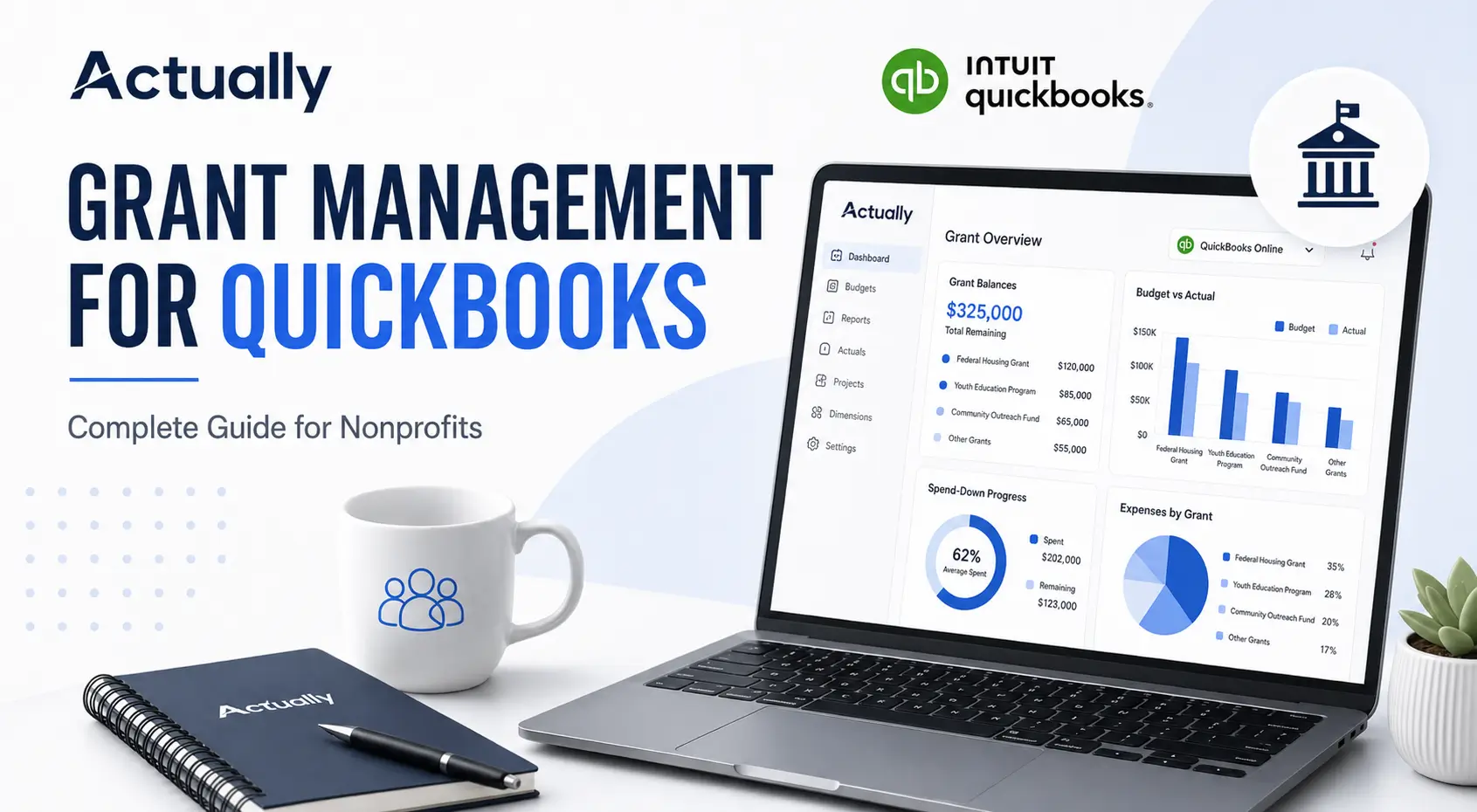
Actually does not determine which percentage is allowable, replace employee activity records, or run payroll. It adds grant-budget visibility around the accounting data and allocation process. Learn more in the grant management guide for QuickBooks Online or review staff allocation tracking methods for nonprofits.
Conclusion
Payroll allocation by percentage is straightforward when the inputs are reliable. Define the cost objectives, select a reasonable allocation basis, calculate each percentage, apply it to the appropriate payroll components, and reconcile the result to the source payroll total.
The formula is only one part of the process. The percentages must reflect the work performed or benefit received, remain consistent with grant terms and accounting policies, and be supported by records that can withstand review. Regular true-ups, clear rounding rules, and monthly reconciliations keep percentage-based salary allocation accurate as staffing and funding change.
For organizations using QuickBooks Online, the accounting system can hold the resulting class, project, customer, or other tracking detail. Actually can then help finance and program teams understand what those allocations mean for each grant budget.
Frequently Asked Questions
What is the formula for payroll allocation by percentage?
Multiply the total allocable payroll cost by the allocation percentage. For example, $5,000 × 40% produces a $2,000 allocation. If the percentage comes from activity records, divide the activity for the cost objective by total compensated activity and multiply by 100.
Should payroll allocation percentages always total 100%?
Yes, when the organization is distributing the employee's entire payroll cost for the period. If only part of a cost is being allocated in a particular schedule, the schedule should clearly identify the excluded portion and reconcile to the complete source total elsewhere.
Can a nonprofit use budget percentages to allocate payroll?
Budget percentages can be useful for planning and may support interim accounting under certain requirements. They should not be treated automatically as the final allocation. For federal awards, the organization must compare interim estimates with records reflecting actual work and make necessary adjustments.
Are payroll taxes and benefits allocated using the same percentage as salary?
They can be when doing so is reasonable, consistent with policy, and allowed by the award. Some organizations use actual benefit costs or a separate fringe-benefit rate. Each payroll component should be identifiable and reconciled.
How often should payroll allocations be updated?
Update them whenever responsibilities or funding change materially, and review them at a frequency that supports timely financial reporting. Many organizations calculate or review allocations each payroll period or during the monthly close.
Does percentage-based payroll allocation require timesheets?
Not every funding arrangement requires the same timesheet format. The organization needs documentation that satisfies its grant terms and applicable rules. For federal awards, records must accurately reflect work performed and be supported by the organization's internal controls.
Can QuickBooks Online split payroll by percentage?
Intuit currently documents percentage entry for salaried employees when tracking payroll expenses by class or project, subject to the organization's QuickBooks Online and payroll setup. Confirm feature availability in the subscriptions being used and reconcile the result to the payroll register.
What is the difference between payroll allocation by grant and by function?
Allocation by grant identifies the funding source or award charged. Allocation by function classifies the cost as program services, management and general, or fundraising. A nonprofit may need to track both dimensions for the same payroll cost.

David Cristello
.svg)
About the Author
David Cristello is the Co-Founder of Actually Finance. He's been an entrepreneur in the accounting and nonprofit space for over 10 years, previously building a company that made the Inc5000 list
.png)







.webp)